
28 October 2026 · 8 min read
Claude for marketing: how founders get real growth advice from it
 Özlem Değirmenci GülserCEO & Co-founder, GrowthWise
Claude for marketing works best as a growth analyst that knows your business: connect it to your real data, tell it your goals and what you already tried, and ask it to decide rather than describe. Without that context, Claude gives the same sensible advice it would give anyone, and you are left choosing your next move alone.
Why generic answers happen
We see this often with founders who are experts in their own field. They use Claude every day for code or contracts, ask it "how do I grow my SaaS?" and get a tidy list of channels. The list is correct. It is also the same list every other founder gets.
Claude reasons well, but in a blank chat it cannot see which numbers you have, whether they are right, what you are aiming for or what you tried last month. So it falls back on what is true for most companies. An AI marketing assistant that answers from averages will sound reasonable and rarely tell you something new. Four steps close that gap.
Step 1: Check your numbers before you ask
This is the step almost every guide skips, and it is the one we would never skip.
If your Google Analytics counts a payment-page return as a sign-up, or your team's visits inflate traffic, Claude will build a confident strategy on a wrong number. A broken conversion event looks exactly like a real one in a report.
Before any strategic question, check the basics: does each key event fire once, are internal visits filtered, do Analytics sign-ups roughly match your own database? Our GA4 audit checklist covers the ten checks that matter. Then tell Claude which numbers you trust and which you do not. That one sentence changes the quality of every answer after it.
Step 2: Connect your data instead of pasting screenshots
Pasting a screenshot gives Claude one view of one day. Connecting a data source lets it ask its own follow-up questions.
The way to do this is the Model Context Protocol (MCP). A Google Analytics MCP lets Claude read your sessions, conversions and channels. A Google Ads MCP lets it read spend, clicks and search terms. If you want to know what each one gives Claude and where it stops, we wrote up what a Google Analytics MCP can and cannot do.
Connect at least two sources. Most growth questions sit where two of them meet.
Step 3: Give Claude your goals and your history
Claude cannot weigh options without knowing what you are trying to achieve. Write a short brief and keep it in a Claude Project so every chat starts with it:
- The goal. One metric for this quarter, such as demo requests or trial sign-ups.
- Where you are. Today's level of that metric, roughly.
- Who you sell to. One or two sentences on the target customer.
- What you tried. Past campaigns and changes, and what happened.
- Constraints. Budget, team size, things you will not do.
The "what you tried" line does more work than it seems. It stops Claude from proposing last quarter's failed experiment as this week's idea.
Step 4: Ask for a decision, then come back to check it
Swap open questions for decision questions. Instead of "how can I improve my marketing?", ask for ranked moves with the data behind them. Here is a question you can paste into Claude as it is; fill in the two brackets:
Our goal this quarter is [one metric, for example demo requests]. Before, we tried [what you tried and what happened]. Using the connected Google Analytics, Search Console and Google Ads data, give me the three moves for this week, ranked by expected impact. For each move, show the numbers it rests on, tell me which of those numbers you are not sure about, and name the metric that will show in two weeks whether it worked.
Then do the part that turns advice into learning. Two weeks after a move is done, come back and ask Claude to compare the two weeks before with the two weeks after, on the metrics you agreed to watch. Ask it to say plainly whether anything changed, and not to claim the move caused it. That is how growth experiments become a record of what works for your company, and how you start to answer your own questions about marketing ROI.
The question for that check:
Two weeks ago we finished [the move]. Compare the two weeks before it with the two weeks after it on [the metrics we chose]. Tell me plainly whether anything changed and by how much, and do not say the move caused it. If the numbers are too small to read, say so.
A real example from our consulting work
This comes from a developer API company serving e-commerce businesses that we worked with. We removed the name and identifying details and rounded the figures. The same month appears in our marketing dashboard checklist; here we follow one finding step by step. It is the same reasoning you can ask Claude to follow once it has your sources connected.
- Trust first. Before anything else, the numbers had to be cleaned. Internal admin pages were counted as visits, and payment-page returns opened new sessions. Sign-ups were counted correctly, so the reasoning could rest on them.
- Read the sources together. Google Ads showed one search term converting well: the main competitor's name plus "api", with a four-figure monthly budget. Search Console showed the same term had about 2,200 impressions a month in organic search, at position 8.5, with only 6 clicks.
- Connect them. The company was paying for demand its own page could have won, and that page already converted well when people reached it. Neither tool shows this alone: Google Ads says the term works, Search Console says the page is almost invisible.
- Decide. The move: one SEO sprint on that page, with a better title, a comparison table and internal links. The ad data had already shown the term was worth money, so this was the move with the largest expected contribution. The ads stayed on until the organic ranking moved.
- Measure. Over the following weeks, watch the page's position and clicks for that term and the sign-ups it brings. Once organic clicks grow, check whether the ad budget on the term can come down.
A blank chat would have suggested "improve your SEO" or "spend more on ads". With trusted numbers and two sources read as one system, the move was specific and testable.
The hard part is the routine
Claude will not check every number unless you ask, and it will not come back in two weeks by itself. These are weekly habits, and they are hard to keep for a founder who also runs the product. Our guide to founder-led growth decisions shows how to keep that routine light.
How GrowthWise helps
GrowthWise is a growth brain for founders: it reads a company's analytics, search and ad data together, checks every number, and tells the team what to do each week, with paid and organic treated as one system. It runs the four steps above for you, and you can use it from your own Claude.
- Trust first. Every Monday you get a Health Score that says how far your numbers can be trusted, before any advice.
- Weekly moves with the data behind them. Each move shows the data rows it rests on, and numbers are checked against their source before the plan is saved.
- Memory. Your company profile, notes and past decisions are read before every plan and answer.
- Did it work? Two weeks after a task is done, the numbers before and after are compared and the result is written on the task.
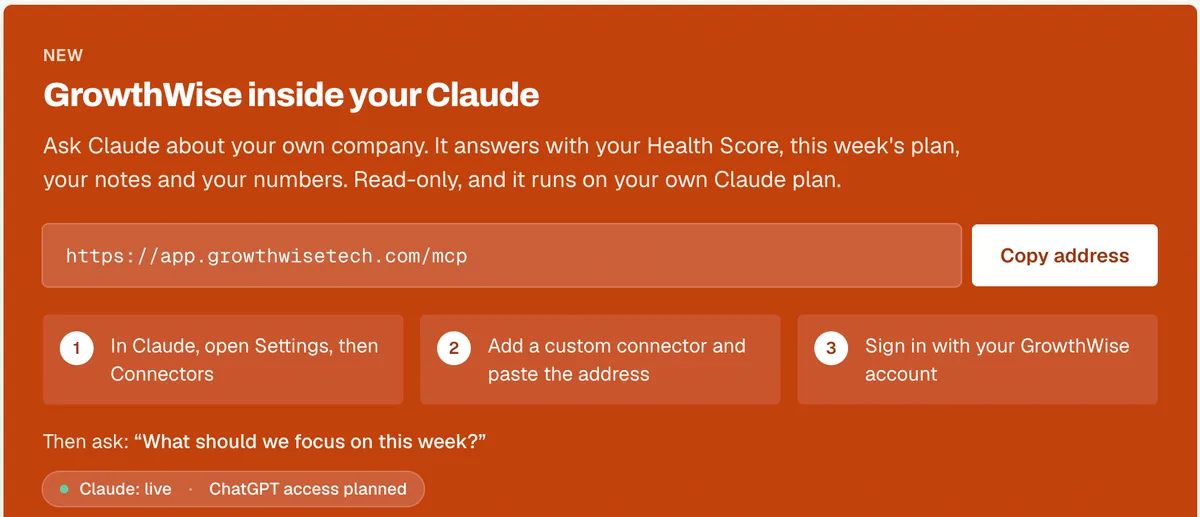
- Inside Claude. The GrowthWise MCP for Claude lets Claude read your Health Score, this week's plan, notes, metrics and results. On paid plans it can also add ideas, notes and tasks and approve the week's plan. It never writes to your Analytics or ad accounts, and your data is not used to train AI models.
The method comes from our consulting work: since 2020 GrowthWise has worked with 42 technology companies. See what GrowthWise does for founders, or start with the free GA4 audit: a Health Score and three moves for this week in about two minutes, read-only and with no credit card.
FAQ
Can Claude do my marketing for me?
Claude can analyse your data, draft plans and answer questions, but someone still has to do the work and decide. It gives much better advice when it is connected to your data and knows your goals.
How do I connect Claude to Google Analytics?
Through an MCP server, which lets Claude read your Analytics data with your permission. You add the server as a custom connector in Claude and sign in with your Google account.
Is it safe to give Claude my marketing data?
Use read-only access through each platform's own sign-in, so nothing in your accounts can be changed. Check how each connector stores and uses your data before you connect it.
Do I need a paid Claude plan to use it for marketing?
Basic chat works on every plan. The free plan allows only one custom connector, so to connect Google Analytics, Google Ads and a tool like GrowthWise at the same time you need a paid plan, starting with Pro.
Is there a Google Ads MCP for Claude?
Yes. A Google Ads MCP server lets Claude read your campaigns, spend, clicks, conversions and search terms after you sign in with Google. Read-only access is enough for analysis. The answers get sharper when the same chat can also read Google Analytics, because most budget questions need both.
Sources
Özlem Değirmenci Gülser
CEO & Co-founder, GrowthWise
Sixteen years on the commercial side of technology companies. Since 2020 GrowthWise has run growth for 42 of them; the product turns that method into a weekly plan.
LinkedIn