
20 October 2026 · 9 min read
Founder-led growth: how to make growth decisions yourself
 Özlem Değirmenci GülserCEO & Co-founder, GrowthWise
Founder-led growth means the founder makes the growth calls until the company can afford someone senior to own them. You can do it well without a growth background if you build three weekly habits: check whether your numbers can be trusted, read your analytics, search and ad data together to pick a few moves, and measure each move after it is done.
Why the decisions land on you
Early on, a junior marketer or a freelancer can run campaigns, but someone still has to decide which campaign, which channel and what to stop. In larger companies a senior growth lead makes those calls. At seed or Series A that hire is often out of reach, so the decisions stay with the founder, who usually knows the product and the customer better than anyone, and growth less well.
Since 2020 GrowthWise has worked inside 42 technology companies as a consultancy, and more than 150 across sixteen years of growth work. We kept seeing the same thing: plenty of data, plenty of tools, and nobody to say what it means. You can read more about how this looks from the founder's seat.
That is not a weakness. Founders who built the product from deep domain knowledge, an accountant building accounting software or a lawyer building a legal product, already know who the customer is and what they need. What is missing is a way to turn the data you already have into a short, defensible list of what to do next.
Step 1: Check whether your numbers can be trusted
Every growth decision rests on numbers: conversions, cost per conversion, organic clicks. If a conversion event fires twice, or the demo form is not tracked at all, every report built on it is wrong, and so is every decision.
Before you change budgets or write new pages, check:
- Are your key events (sign-ups, demo requests, purchases) recorded once, and only once?
- Do your ad platform and your analytics roughly agree on conversions?
- Is traffic you cannot explain ("Direct", "Unassigned") growing?
Our GA4 audit checklist walks through each check, and a free GA4 audit runs them on your property in about two minutes.
If the answer is no, fixing measurement is your first growth move. It is not glamorous, and it is the one that makes every later move measurable.
Step 2: Read all your sources together, then choose a few moves
A marketing dashboard tells you what happened in one channel. It rarely tells you what to do. The decisions that move growth sit between the channels, so read everything you have together: analytics, search, every ad platform and your CRM.
Paid and organic are one system. Google Ads shows a query that converts well, Search Console shows your own page for that query ranking just below the first page, and Analytics shows that visitors who reach the page convert. Each number alone is a fact. Together they are a decision: improve the page, and once it ranks, spend less on that query in ads.
Here is the reasoning step by step, with example numbers.
- Say a query brings you 30 conversions a month from ads.
- Search Console shows your own page for that query at position 11, just off page one.
- Analytics shows that 4% of visitors who land on that page convert, so the page is worth improving.
- Once it reaches page one, the ad spend on that query can come down, because organic now catches the same buyers. One move, three sources, and a clear way to check it later.
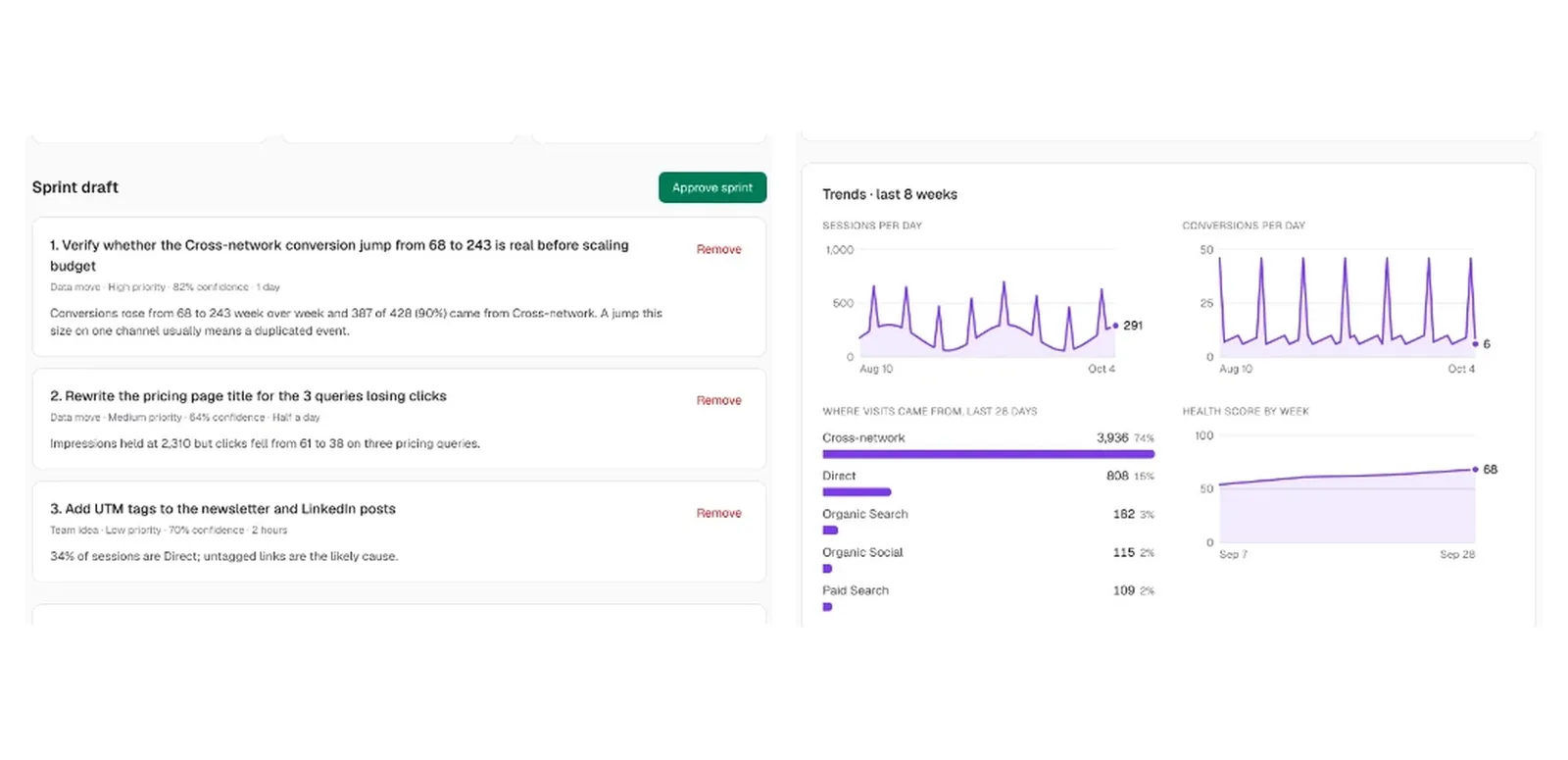
Keep the weekly list short. Three moves you finish beat ten you start. For each move, write down why (with the numbers behind it), what should change, and which two or three metrics will tell you whether it worked.
Step 3: Measure each move after it is done
Growth experiments only teach you something if you look back. Two weeks after a move is finished, compare the metrics you named with the two weeks before it. On a quiet site, look over four weeks, or at an early signal such as sessions or engagement, because a handful of conversions will not move enough to read.
Read the result as "since the move", never "because of the move": many things change in two weeks. We explain how in marketing ROI for founders.
Write down what you tried and what happened, including what did not work. That record is what a senior growth lead would bring with them, and it is what keeps you from repeating last quarter's experiment.
A weekly rhythm that fits a founder's calendar
- Monday: check that the numbers are sound, pick this week's moves, assign them.
- During the week: your team or agency does the work; questions go to one place.
- Friday: what got done? Unfinished moves are finished, handed over or dropped.
- Two weeks later: did it work?
This is a B2B SaaS growth strategy you can run in an hour a week, and it gets better with every week you record.
If you already work in Claude, here is how to set Claude up for marketing decisions.
When to hand the decisions over
Hire when the decisions take more time than you have and the channels are proven enough to scale. Until then, founder-led growth works when the judgment is structured: trusted numbers, a few moves with clear reasons, and honest measurement.
How GrowthWise helps
GrowthWise is the growth decision layer for founders. It reads your analytics, search and paid channels together (Google Analytics, Search Console, Google Ads and LinkedIn Ads) and does the first two steps with you every Monday: a Health Score that shows how far your numbers can be trusted, and a few moves for the week, each with the data it is based on and step-by-step instructions for your team. Two weeks after each move is done, it checks whether the numbers it named moved.
Start with the free GA4 audit: connect Google Analytics and see your Health Score and three moves in about two minutes, or see the plans.
FAQ
What is founder-led growth?
It is the stage where the founder makes the growth decisions, before the company hires someone senior to own them. It works when those decisions rest on trusted numbers and are measured afterwards.
Do I need a growth background to do it?
No. You need a weekly habit: check your numbers, read your sources together, pick a few moves with clear reasons and check whether they worked.
How often should I review growth moves?
Pick moves every Monday, check what got done on Friday, and measure each finished move two weeks later (four weeks on a quiet site).
What is the difference between founder-led growth and founder-led sales?
Founder-led sales is the founder closing deals personally. Founder-led growth is wider: the founder also decides where the next customers come from and which marketing to keep.
When does founder-led growth stop working?
When the growth decisions take more time than the founder has, or the channels are proven enough to scale. That is the moment to hand the decisions to a senior hire.
Sources
Özlem Değirmenci Gülser
CEO & Co-founder, GrowthWise
Sixteen years on the commercial side of technology companies. Since 2020 GrowthWise has run growth for 42 of them; the product turns that method into a weekly plan.
LinkedIn